Choose an industrial descaling chemical only after identifying the mineral scale or oxide and confirming every metal, weld, seal and coating in the flow path. Remove oily soil first, test a representative coupon, control concentration, time and temperature, rinse completely, inspect the dry surface and characterize the spent solution.
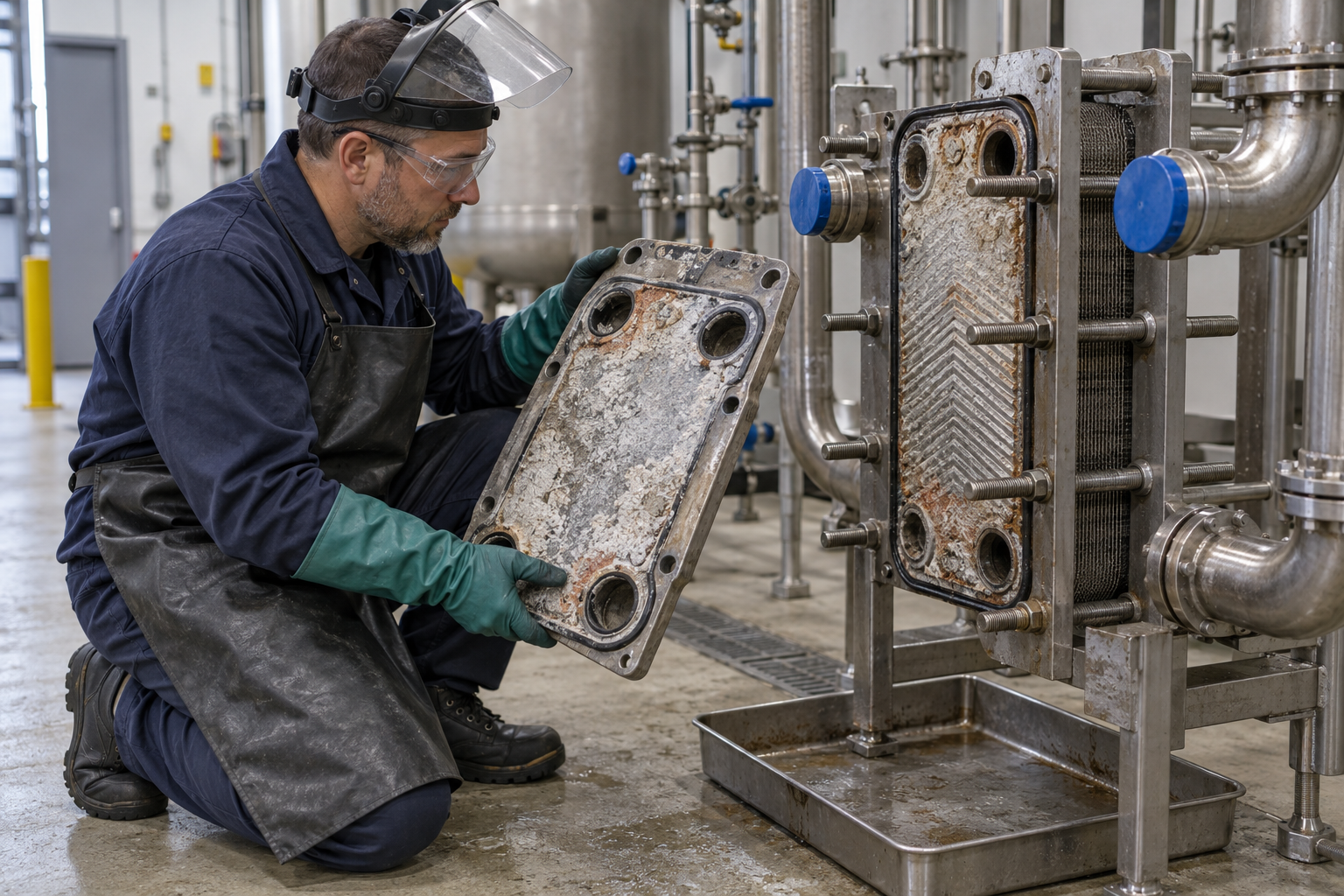
White crust on a heat exchanger, brown deposits around a flange, and a dull film inside a metal line may look like one cleaning problem. They are not. Mineral scale, corrosion products, process residue, and grease respond to different chemistry, and the wrong choice can damage the equipment without removing the deposit.
Choosing an industrial descaling chemical starts with three questions: What is the deposit? What materials will the solution touch? Where will the spent cleaner and rinse water go? Once those answers are clear, concentration, temperature, circulation, and contact time can be tested under controlled conditions.
This article provides a practical selection framework, not a universal descaling recipe. The current product label, Safety Data Sheet, equipment manual, metallurgy guidance, site procedures, and wastewater requirements must control the job.
Scale, rust and grease are different soils
Mineral scale forms when dissolved material precipitates from water or process fluid. Calcium carbonate is common in hard-water systems, but silica, iron, magnesium, and process-specific minerals may also be present. Rust is an iron corrosion product. Heat-tint, weld oxide, product residue, and oily film create other surface conditions.
Do not identify a deposit by color alone. Review water or process records, operating temperature, makeup-water quality, and maintenance history. If the material is unknown or the equipment is valuable, send a sample for analysis. A small laboratory result can be cheaper than an avoidable alloy failure.
Grease and oil should usually be removed before acid descaling. An oily film can shield mineral deposits and consume cleaning effort. Separating the alkaline degreasing step from the acid step also makes rinsing and chemical control easier to verify.
Know every material in the flow path
The visible shell or plate is only part of the system. A descaling solution may also contact welds, brazing material, gaskets, seals, pump components, valves, sensors, sight glasses, coatings, drain lines, and temporary hoses.
Confirm the base metal and the exact alloy where possible. Carbon steel, stainless grades, aluminum, copper alloys, zinc, and mixed-metal assemblies do not respond identically to acid. An acid that removes scale quickly may also etch the base metal, attack a weld, darken a soft alloy, or shorten gasket life.
Ask the equipment manufacturer whether chemical cleaning is permitted and which limits apply. For a mixed-metal system, the most vulnerable exposed component may determine the process.
What acid descaling does
Acidic cleaners react with certain mineral deposits and metal oxides so they can be loosened, dissolved, and carried away. EPA metal-finishing guidance describes acid cleaning as using inorganic or organic acids, sometimes with wetting agents or detergents, to remove dirt, oxide, rust, or scale from metal surfaces. Review EPA metal-finishing process guidance.
The acid name alone does not establish suitability. Formulation strength, inhibitors, surfactants, deposit chemistry, alloy, temperature, and exposure time all affect the result. A fast reaction is not necessarily a good reaction if it also removes base metal.
Use a representative compatibility test
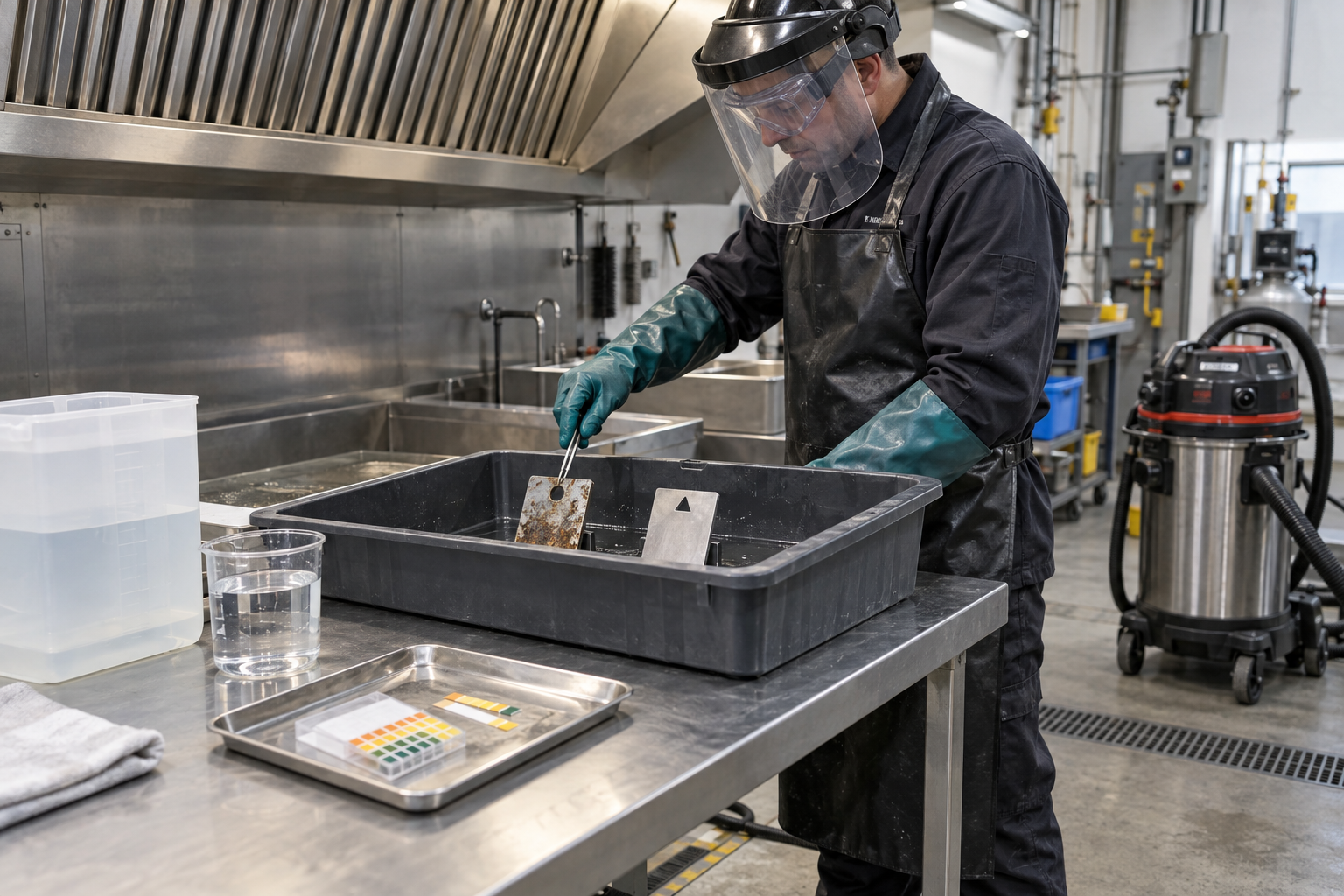
Before treating the full system, test a removable part, material coupon, or inconspicuous area that represents the equipment. Include the actual gasket or seal material when practical. Follow the product's written starting concentration, temperature, and contact-time limits.
Record:
- Product, lot, concentration, and solution volume
- Deposit type and thickness
- Metal alloy, weld, coating, gasket, and seal materials
- Temperature, agitation or circulation, and elapsed time
- Visible reaction, gas generation, color change, and deposit release
- Rinse-water condition and final dry appearance
Compare the cleaned coupon with an untreated reference. Look for pitting, etching, darkening, loss of finish, dimensional change, gasket swelling, and flash rust after rinsing. Do not approve the process solely because the scale disappeared.
Build a controlled work plan
- Isolate and drain. Use the facility's energy-control procedure and verify that pressure, heat, and flow are removed.
- Inspect the system. Identify materials, damage, access limits, and places that may trap solution.
- Remove incompatible residue. Clean oil or product soil with the approved separate process and rinse completely.
- Protect the area. Establish ventilation, secondary containment, compatible transfer equipment, emergency controls, and a collected-waste route.
- Prepare solution correctly. Follow the manufacturer's order of addition and never improvise a stronger mixture.
- Monitor the process. Track time, temperature, flow, reaction, and any product-specific control test.
- Stop at the acceptance point. Do not extend contact simply because solution remains available.
- Drain, recover, and rinse. Follow the written procedure and collect all spent solution and rinses.
- Inspect dry equipment. Check deposit removal, metal condition, seals, low points, and corrosion risk before reassembly.
Never mix acid cleaner with bleach
An acidic descaler must be kept away from hypochlorite bleach and other incompatible chemicals. CDC and NIOSH warn that combining acidic cleaning agents with sodium hypochlorite can release toxic chlorine gas. See NIOSH chemical-mixing guidance.
Physically separate incompatible products in storage and during the job. Clearly label transfer containers and hoses. If the system previously held a sanitizer or another cleaner, verify the required drain and rinse sequence before acid is introduced. Never rely on odor to confirm that a hazardous gas is absent.
Plan for corrosive exposure before work starts
Use the SDS and a workplace hazard assessment to select acid-resistant gloves, splash goggles, face protection, clothing, boots, and respiratory controls. Inspect the PPE and transfer equipment before use. Provide trained personnel, a spill plan, and immediate communication and medical-response procedures.
OSHA requires suitable facilities for quick drenching or flushing where workers may be exposed to injurious corrosive materials. Review OSHA 29 CFR 1910.151. The eyewash or shower must be accessible for the actual work location; PPE is not a substitute.
Spent descaler is not the original product
As descaling proceeds, the solution can accumulate dissolved metals, scale, corrosion products, and process residue. Rinse water carries those contaminants too. EPA guidance identifies spent acidic cleaning solutions and rinses as wastewater sources in metal-cleaning operations.
Do not neutralize or discharge the solution based on a generic blog procedure. Sampling, treatment, permitted discharge, recycling, and off-site disposal requirements depend on the contaminants, process, facility, and local authority. Arrange the route before beginning the job and keep incompatible waste streams separate.
How to judge whether the process worked
The acceptance test should match why the equipment was descaled. Possible measures include restored heat transfer, improved flow, pressure-drop change, visual cleanliness, deposit weight removed, a verified water break, or preparation for a specified coating or finishing step.
Appearance alone can mislead. Bright metal may have been over-etched, while a slightly discolored but intact surface may meet the operational goal. Record the starting condition, process data, final inspection, photos, and any remaining limitation so the next cleaning interval is based on evidence.
Questions to ask a descaling supplier
- Which mineral deposits and oxides is the product intended to remove?
- Which alloys, welds, seals, coatings, and temporary equipment are compatible?
- What starting concentration, temperature, contact time, and monitoring method apply?
- Does the formulation include corrosion inhibitors, and what are their limits?
- What visible reaction is normal, and what condition requires an immediate stop?
- What rinse, drying, and flash-rust controls are required?
- What data is needed to characterize the spent cleaner and rinse water?
Clean-X Deoxal
Clean-X Deoxal is listed in Keystone Clean-X's Aluminum Brightener and Acid Cleaner category. The SDS-based product guide identifies it as an inorganic acidic detergent for metal deoxidizing, scale removal, mineral-deposit removal, and metal brightening. It contains sulfuric acid and is corrosive.
Review the current Safety Data Sheet and contact Keystone Clean-X before selection. Provide the equipment type, all known materials, deposit analysis or water data, operating temperature, cleaning method, containment, and waste route. That information is more useful than asking for one dilution to fit every system.
Sources and further reading
Frequently asked questions
What chemical removes mineral scale from metal equipment?
Acidic descaling products can dissolve certain mineral deposits and metal oxides, but the correct formulation depends on the scale chemistry, base-metal alloy, welds, seals, coatings, temperature and cleaning method.
Is rust the same as mineral scale?
No. Rust is an iron corrosion product, while mineral scale precipitates from water or process fluid. They may occur together, so identify the deposit before choosing chemistry.
Can industrial descaler damage stainless steel?
It can if the acid, concentration, temperature or contact time is incompatible with the specific stainless grade, welds or surface condition. Obtain written guidance and run a representative compatibility test first.
Can acid descaler be mixed with bleach?
Never mix acidic cleaner with hypochlorite bleach. The combination can release toxic chlorine gas. Keep incompatible products, transfer equipment and waste streams physically separated.
Can spent descaling solution go down a drain?
Do not assume it can. Used solution and rinse water may contain dissolved metals and process contaminants. Characterize the waste and follow facility, sewer-authority and environmental requirements for treatment or disposal.