Choose a restaurant hood cleaning degreaser by matching the grease condition, metals, application method, temperature and rinse requirements. Verify compatibility on a test section, contain all runoff, follow the current SDS and local fire-code requirements, and confirm clean accessible surfaces across the full contracted system.
A successful kitchen exhaust job is not defined by how aggressive the chemical smells, how much foam it produces, or how quickly it darkens the runoff. The result that matters is a properly cleaned system, protected surrounding equipment, controlled wastewater, no harmful chemical residue, and clear documentation of the work.
That makes choosing a restaurant hood cleaning degreaser a process decision rather than a simple product comparison. The contractor must consider the grease, metal, access, temperature, application equipment, dwell behavior, rinse demand, worker exposure, and local fire-code requirements before choosing a concentrate or ready-to-use cleaner.
This guide is written for professional commercial kitchen exhaust cleaners and facility teams. Full hood, duct, and fan cleaning can require trained, licensed, or certified contractors depending on the jurisdiction. The current product label, Safety Data Sheet, equipment instructions, fire-protection requirements, and local authority must govern every job.
First define what is being cleaned
A commercial cooking exhaust system extends beyond the stainless canopy visible from the kitchen. The work scope may include grease-removal devices, baffle filters, the hood interior, plenum, accessible ductwork, access panels, fan housing, fan blades, rooftop surfaces, and pollution-control equipment. Different surfaces and access conditions can require different tools and application methods.
A restaurant employee washing removable filters is not performing the same task as a qualified company cleaning an entire grease exhaust system. For example, New York City requires licensed companies and individuals for exhaust ducts and system components above the hood. Other states and municipalities in the Northeast and Mid-Atlantic have their own adopted codes and enforcement practices. Confirm the requirements for the actual job location instead of applying one city's rule everywhere.
The 2024 edition of NFPA 96 addresses ventilation control and fire protection for commercial cooking operations, including inspection, cleaning, and maintenance. The authority having jurisdiction determines which edition and local amendments apply.
Identify the grease before selecting chemistry
Kitchen exhaust deposits vary with the menu, appliance, cooking volume, fuel, exhaust temperature, and interval since the last effective cleaning. Fresh fryer oil may remain soft and mobile. A charbroiler can create a tougher mixture of animal fat and carbon. Solid-fuel cooking adds particulate matter. Older layers may be oxidized, baked, and difficult to penetrate.
Inspect representative areas rather than judging only the front lip of the hood. Record:
- Whether the deposit is soft, tacky, waxy, brittle, or heavily carbonized
- Its approximate thickness and whether layers separate during scraping
- The cooking equipment and fuels under the hood
- Previous cleaning products or coatings, if known
- Cold zones, horizontal runs, elbows, fan areas, and other collection points
- Any inaccessible area that cannot be evaluated or cleaned through existing access
Remove heavy accumulations mechanically where appropriate before relying on chemistry to carry the entire load. Scraping bulk grease can reduce chemical use, dwell cycles, rinse water, and the volume of greasy wastewater. Chemical action should support the cleaning plan, not compensate for inadequate access.
What strong alkaline degreasers do
Many professional hood-cleaning compounds are strongly alkaline because alkaline builders can break down or loosen cooked fats and oily deposits. Surfactants help wet the surface and carry soil into the wash solution. Hydrotropes and other formulation components can support stability, penetration, and rinsing.
Formulation matters more than pH alone. Two products with similar alkalinity may cling, wet, rinse, and react with metal differently. A high-strength caustic cleaner may shorten dwell on a compatible stainless surface but also increases the consequence of overspray, incorrect dilution, inadequate PPE, or contact with an incompatible metal.
Never mix a hood degreaser with bleach, acid, sanitizer, solvent, or another cleaning product unless the manufacturer provides explicit written instructions. Mixing can create heat, hazardous vapors, splashing, or unpredictable performance.
Match the cleaner to every exposed material
Commercial hoods and ducts are commonly stainless steel, but a job can also expose aluminum filters or fan components, galvanized metal, painted panels, plastics, gaskets, wiring, flooring, countertops, and rooftop membranes. Fire-suppression nozzles, fusible links, detection components, and electrical controls require particular protection and must not be treated like ordinary metal surfaces.
A cleaner suitable for stainless steel may darken, etch, or otherwise damage aluminum and other soft metals. Identify uncertain components before work starts. If the product documentation does not explicitly cover a surface, obtain guidance from the chemical and equipment manufacturers and test a noncritical area under controlled conditions.
Compatibility also includes the application equipment. Verify that sprayers, hoses, seals, pumps, brushes, and collection containers are rated for the prepared solution.
Concentrate or ready to use?
A concentrate can give an experienced contractor flexibility across different grease loads and may reduce shipping and storage volume. It also requires controlled dilution, compatible dispensing equipment, labeled secondary containers, and trained employees. Measuring by appearance or using an informal “stronger is better” approach undermines both safety and consistency.
A ready-to-use product can reduce dilution error and simplify smaller or targeted tasks. The tradeoff may be higher delivered cost per usable gallon and less flexibility for unusual soil. It still requires an SDS review, compatible PPE, labeling, containment, and surface testing.
Compare the actual cost per completed job: usable solution, application time, dwell, repeat passes, rinse water, labor, wastewater handling, surface risk, and callbacks. Container price alone does not show which option is more economical.
Application behavior affects both cleaning and control
Vertical hood and duct surfaces demand enough contact time for chemistry to work. A very thin solution may run off before the deposit loosens. A clinging foam or gel can extend contact, but more foam is not automatically more cleaning. It can increase rinse demand and make it harder to confirm that residue has been removed.
Temperature can influence grease and detergent performance, but it must remain within the cleaner, sprayer, pressure washer, and surface limits. Excess heat can increase vapor, accelerate drying, create splashing hazards, or bake remaining residue. Follow the manufacturer's written temperature and dwell instructions.
Apply from a controlled position with the kitchen inactive. Avoid atomizing corrosive chemistry or directing liquid toward unprotected electrical and fire-protection components. Keep the product wet for only the specified dwell period, work manageable sections, and never let concentrated chemistry dry on the surface.
Prepare containment before opening the chemical
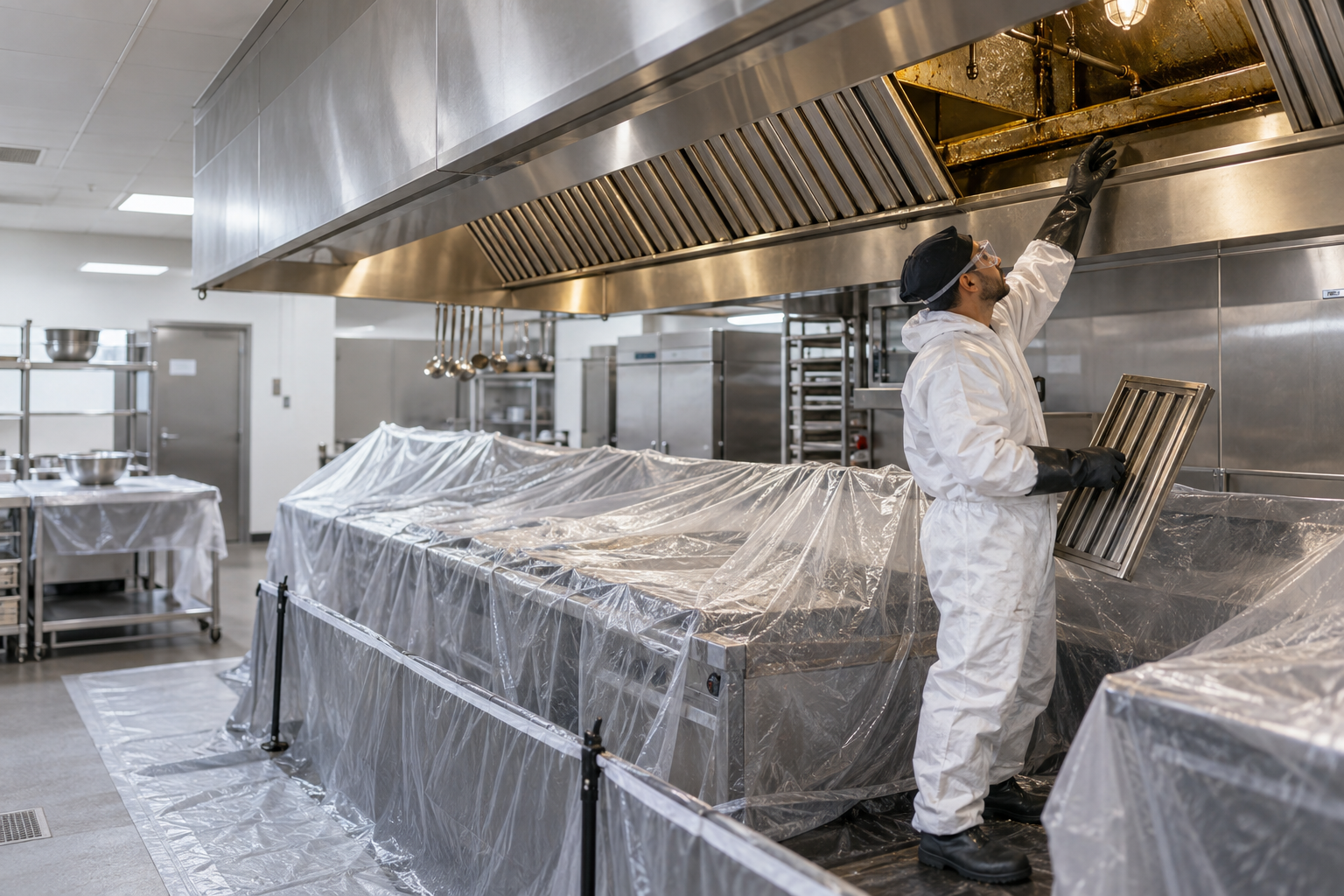
Containment protects food-contact areas, appliances, floors, workers, and the building. Remove food, utensils, and removable kitchen equipment from the cleaning zone where possible. Cover items that remain. Establish a contained path for greasy wash water before spraying overhead surfaces.
The NFPA 96 technical committee's published material on exhaust cleaning discusses preparation that includes shutting down and locking out the fan, extinguishing open flames, protecting cooking equipment, using appropriate PPE and access equipment, and collecting wash water and solid waste for disposal. Review the NFPA committee report.
A job-specific plan should address fan and appliance energy, fuel sources, rooftop access, fall protection, wet floors, chemical transfer, ventilation, emergency eyewash or flushing, spill response, and who is authorized to restore the system after cleaning. Do not disable or disturb a fire-suppression system outside the procedures permitted by the authority and qualified service providers.
Use a controlled test section
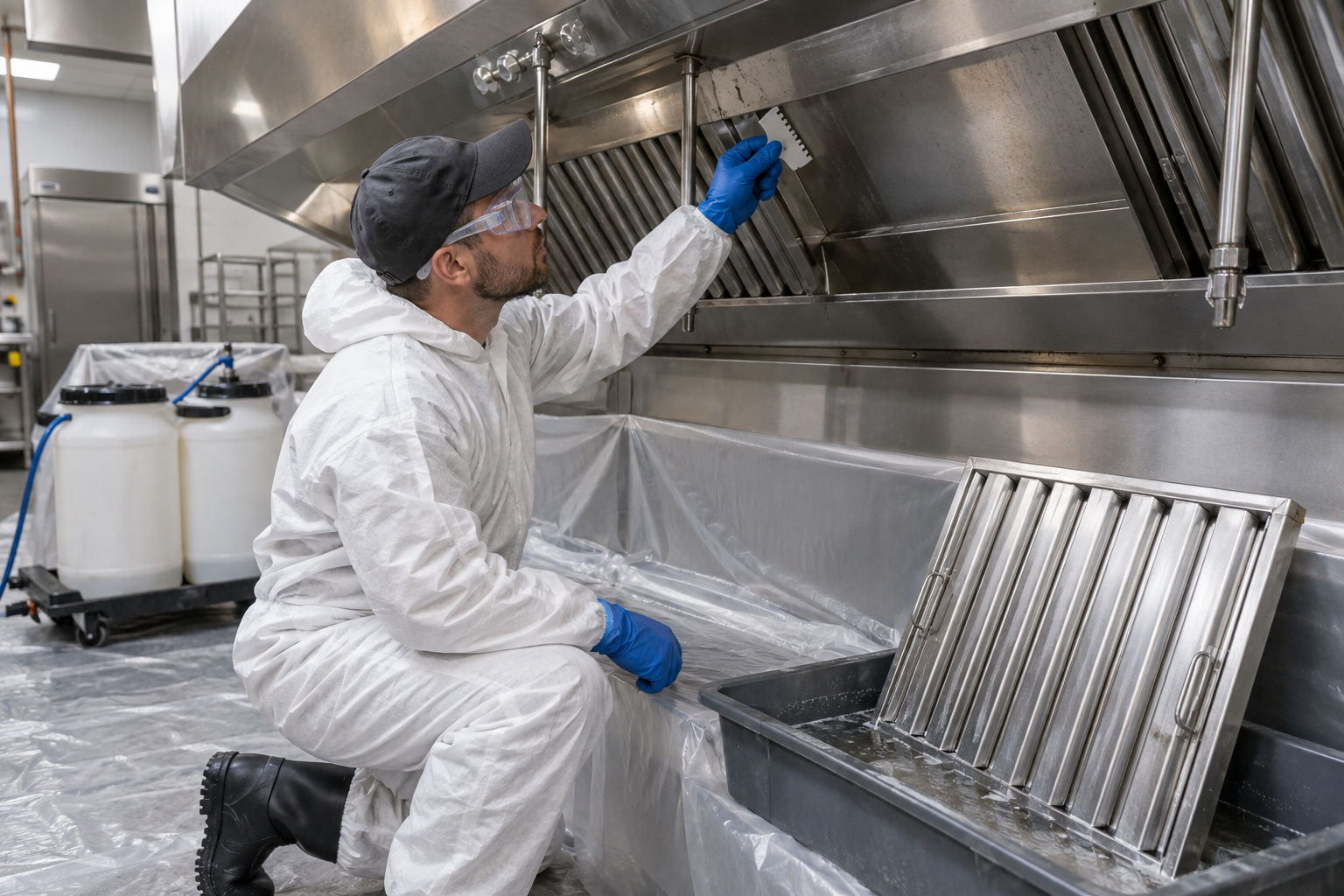
Before broad application, test the prepared solution on a representative, accessible surface. Follow the label for dilution, application, temperature, dwell, agitation, and rinse. Observe whether the cleaner wets the deposit, stays in place long enough, releases the grease, and rinses without a film or metal change.
Record the exact process instead of relying on memory. If a second pass is needed, determine whether the limitation is chemistry, grease thickness, insufficient mechanical removal, temperature, dwell, or access. Increasing concentration should not be the automatic response.
Rinsing is part of the chemical process
A loosened grease film is not the final result. The soil and cleaner must be removed from the system without spreading contamination. Incomplete rinsing can leave alkaline residue, streaks, slippery surfaces, odors, or material that attracts new soil.
Rinse method and volume should match the product instructions, system geometry, containment capacity, and local wastewater requirements. Work from clean-to-dirty zones where practical and prevent runoff from recontaminating completed surfaces. Check seams, corners, filter channels, access-panel edges, and fan housings where liquid can collect.
When saponifying agents are used, residues must not remain in the exhaust system. New York City's fire-code guidance is one clear example: it calls for surfaces to be cleaned to bare metal, prohibits flammable cleaning fluids, requires removal of saponifying-agent residue, and prohibits applying cleaning fluid to fusible links or other detection devices. See the FDNY commercial cooking guidance. Contractors outside New York City should use their own governing code and authority.
Do not send grease and cleaner to a storm drain
Hood-cleaning wastewater can contain fats, oils, grease, carbon, food residue, metals, and cleaning chemicals. “Water based” or “biodegradable” does not make that combined waste stream acceptable for uncontrolled discharge.
Collect liquid and solids as the job proceeds. Confirm approved discharge, pretreatment, hauling, and disposal methods with the local sewer authority, property manager, and environmental requirements before the work begins. The U.S. Environmental Protection Agency warns that grease and oil can clog pipes and pollute waterways and should not be washed into storm drains. Review EPA restaurant stormwater practices.
Protect workers from corrosive cleaning chemicals
OSHA notes that oven, grill, and other restaurant cleaning products can be caustic and may cause burns or eye and skin irritation. Employers using hazardous chemicals need an effective hazard-communication program, workplace labels, accessible Safety Data Sheets, training, and suitable protective measures. See OSHA restaurant cleanup guidance.
Select gloves, eye and face protection, protective clothing, footwear, and respiratory controls from the current SDS and a workplace hazard assessment—not from a generic product category. Train workers for charging sprayers, overhead application, line clearing, spill response, PPE removal, and first aid. Inspect PPE before every job and replace degraded items.
Verify the whole scope, not just the visible hood
A shiny hood face can conceal missed grease in the plenum, duct, access-panel edges, or fan. The final inspection should follow the agreed scope and governing standard. Use before-and-after photographs tied to identifiable locations. Document inaccessible or damaged areas rather than implying they were cleaned.
A useful closeout record includes:
- System and location identification
- Date, responsible company, and qualified personnel
- Components inspected and cleaned
- Pre-cleaning condition and representative grease measurements where required
- Chemistry and process records required by company policy
- Before-and-after photographs
- Access limitations, deficiencies, damage, or repair recommendations
- Wastewater and solid-waste handling record
- Required service label, certificate, or report for the jurisdiction
Questions to ask a degreaser supplier
- Which kitchen grease conditions and application methods is the cleaner designed for?
- Which metals, coatings, sprayers, seals, and hoses are compatible?
- Is the product concentrated or ready to use, and how must its dilution be verified?
- What surface and solution temperature limits apply?
- What dwell, agitation, and rinse requirements are written on the label?
- What PPE, ventilation, storage, and emergency controls appear in the current SDS?
- What should the operator do if the product contacts aluminum or another incompatible surface?
- Can the supplier help evaluate a representative grease sample and test section?
Keystone Clean-X hood and vent cleaners
Keystone Clean-X lists Clean-X 86 Concentrate and Clean-X 86 Ready to Use in its Commercial Kitchen Hood & Vent Cleaners range. These formats let a contractor discuss controlled dilution needs, soil conditions, application equipment, and job size with the supplier rather than choosing by strength alone.
Review the current Safety Data Sheet library and contact Keystone Clean-X before selection. Provide the hood and duct materials, grease type and age, application equipment, water conditions, temperature, containment method, and governing jurisdiction so the recommendation is based on the actual job.
Sources and further reading
Frequently asked questions
What type of degreaser is used for restaurant hood cleaning?
Professional contractors commonly use alkaline degreasers formulated to loosen cooked fats and greasy deposits. The correct product depends on grease condition, metal compatibility, application equipment, temperature, dwell and rinse requirements.
Can caustic degreaser be used on aluminum hood filters?
Do not assume it can. Strong alkaline cleaners may darken or damage aluminum and other soft metals. Identify the filter material, check the product documentation, obtain supplier guidance and test a noncritical area first.
Does more concentrated hood cleaner work better?
Not necessarily. Excess concentration can increase worker exposure, surface damage, residue, rinse demand and chemical cost. Use the label dilution and a controlled test rather than estimating strength by appearance.
Can restaurant employees clean the entire exhaust system?
Rules vary by jurisdiction. Routine removable-filter care is different from cleaning hoods, plenums, ducts and fans. Some jurisdictions require licensed or certified companies and qualified individuals for full-system cleaning.
Where should hood-cleaning wastewater go?
Collect the wastewater and solids, then follow the local sewer authority, property and environmental requirements for pretreatment, discharge, hauling or disposal. Greasy chemical wash water should never be allowed to enter a storm drain.