

Choose commercial truck wash soap by matching the product to the fleet's soil, surfaces, water, wash equipment, safety requirements, and finish standard. Confirm the real cost with a controlled field trial that measures concentrate, labor, rinsing, and rewashing per acceptable vehicle.
The best commercial truck wash soap is not a universal product. It is the product that removes the soil your fleet actually collects, works through your equipment, respects the surfaces on your vehicles, and produces a repeatable result at a sensible cost per clean vehicle.
That distinction matters for fleets operating across New Jersey, Pennsylvania, New York, Delaware, Maryland, and Connecticut. A local delivery fleet washed every week has a different cleaning problem from long-haul tractors, refuse trucks, refrigerated trailers, dump bodies, or construction equipment. Winter brine, diesel residue, insects, clay, grease, and ordinary traffic film also respond differently.
This guide gives fleet managers, wash-bay supervisors, distributors, and professional washers a practical way to compare commercial truck wash soap without relying on vague claims, foam volume, or container price.
Start with the fleet, not the product catalog
Before asking which soap is strongest, write a short wash profile. The profile should describe what is being washed, how often it is washed, what the vehicles encounter, and what an acceptable result looks like. A supplier can make a better recommendation when the operating conditions are specific.
Record the following:
- Vehicle types and approximate number washed per week
- Typical routes, industries, and seasonal exposure
- Current wash frequency and time available per unit
- Paint, decals, polished or raw aluminum, stainless steel, fiberglass, rubber, and other sensitive surfaces
- Main soils and the areas where they accumulate
- Pressure washers, foam equipment, injectors, brushes, reclaim equipment, and water source
- Finish standard, such as basic maintenance cleaning, customer-facing presentation, or preparation for inspection
A mixed fleet may need more than one approved process. Trying to make one aggressive product handle every truck, van, wheel, polished tank, and piece of equipment can create more risk than convenience.
Identify the soil that is costing time
Look beyond the word dirt. A wash chemical must reach and release a particular soil from a particular surface.
| Observed soil | Where it often appears | Selection question |
|---|---|---|
| Light dust and routine traffic film | Frequently washed delivery vehicles and vans | Can a maintenance detergent meet the finish standard without unnecessary strength? |
| Diesel soot and oily road film | Tractors, exhaust areas, lower panels, and rear doors | Does the detergent release petroleum and carbon soil at the approved concentration? |
| Heavy grease | Frames, equipment, engines, and work trucks | Should the heavy soil receive a targeted degreaser instead of stronger soap across the whole vehicle? |
| Winter brine and mineral residue | Lower panels, wheels, underbody areas, and trailer fronts | Does the wash program address mineral soil without harming the finish? |
| Clay, mud, and aggregate dust | Construction, landscape, and off-road fleets | What needs to be removed mechanically before detergent application? |
| Protein or food residue | Specialized transport and processing vehicles | Are the product, procedure, and regulatory controls suitable for that operation? |
If several soils are present, decide which one is responsible for rewashing or extra brushing. That problem should drive the trial. A stronger whole-vehicle detergent is not always the most efficient answer.
Inventory every surface the soap may touch
A truck is a collection of materials, not one washable surface. Painted steel, clear-coated parts, aluminum, chrome, glass, plastics, seals, decals, and reflective tape can react differently to the same chemistry. Age and condition matter too. Weathered paint and damaged coatings deserve more caution than a new factory finish.
Ask the supplier for written surface guidance and restrictions. Read the label and the current Safety Data Sheet. If polished aluminum, specialty graphics, or an unfamiliar coating is present, test a small inconspicuous area before approving the product for the fleet.
Do not treat an aluminum brightener, heavy-duty degreaser, and routine fleet soap as interchangeable products. Each has a different job. Separating those jobs helps protect the vehicle and prevents unnecessary chemical exposure.
Match the soap to the wash method
The same concentrate can produce very different results when the delivery equipment changes. Tell the supplier whether the product will be applied through a downstream injector, proportioner, low-pressure applicator, foam device, automatic arch, brush system, or manual bucket wash.
Then verify four practical points:
- Can the equipment meter the required final concentration? Injector draw rates and pressure conditions vary.
- Will the product flow through the system? Viscosity, temperature, hose length, and nozzle condition can affect delivery.
- Can the crew maintain even coverage? Missed areas and heavy overlaps create inconsistent results.
- Can the vehicle be rinsed completely in the available time? A product that cleans well but extends the rinse beyond the operating window may not suit the site.
If the operation uses a touchless or two-stage program, the products should be selected as a documented system rather than assembled from unrelated chemicals. For a routine one-step or brush wash, prioritize the soil-removal and surface characteristics required for that method.
Account for water and weather
Water is most of the working solution, so its condition affects the outcome. Hardness minerals can interfere with detergency and contribute to spotting. Reclaimed water may require treatment and process controls. Temperature affects chemical activity, viscosity, dwell time, and the likelihood that a panel will dry before it is rinsed.
A Northeast fleet should test under more than one season when possible. A mixture that performs well on a mild spring day may behave differently on a cold January morning or a hot trailer in direct sun. The operating procedure should define when to reduce the section size, move the vehicle, change the water conditions, or stop washing rather than compensate by guessing at a stronger mix.
Read beyond marketing terms
Words such as concentrated, biodegradable, touchless, heavy duty, and fleet safe need context. They do not tell the operator the final use concentration, surface restrictions, protective equipment, disposal requirements, or whether the product fits the installed equipment.
Review the product label, technical sheet, and SDS together. The Occupational Safety and Health Administration notes that a green name or environmental claim does not automatically mean a cleaning chemical is safe. Employers still need appropriate dilution procedures, training, storage, labeling, and protective measures. Read OSHA and NIOSH guidance for workers using cleaning chemicals.
Useful supplier information should answer:
- What soils and surfaces is the product intended for?
- What is the approved concentration range for the application method?
- What surfaces or conditions require caution?
- What PPE, storage, incompatibility, and spill controls apply?
- Is the product meant for brushing, pressure application, touchless washing, or a paired system?
- What packaging and handling arrangement suits the site?
Calculate cost per clean vehicle
Container price is easy to compare and often misleading. A concentrate with a higher purchase price may cost less per wash if the working concentration is lower and the process reduces labor or rewashing. The reverse is also possible when equipment cannot meter the product consistently.
Use actual site measurements:
- Measure how much concentrate the equipment consumes during a representative test.
- Divide concentrate cost by the number of acceptable vehicles cleaned.
- Add labor time, water, energy, and any repeated work.
- Record damage, spotting, residue, or finish correction as failures rather than hiding them in the average.
Working cost per vehicle = chemical used + labor + water and energy + rewash or correction cost.
The lowest chemical cost is not the lowest operating cost when the crew spends extra minutes brushing every unit. Likewise, a fast product is not economical if it creates finish problems or cannot be used across the intended vehicles.
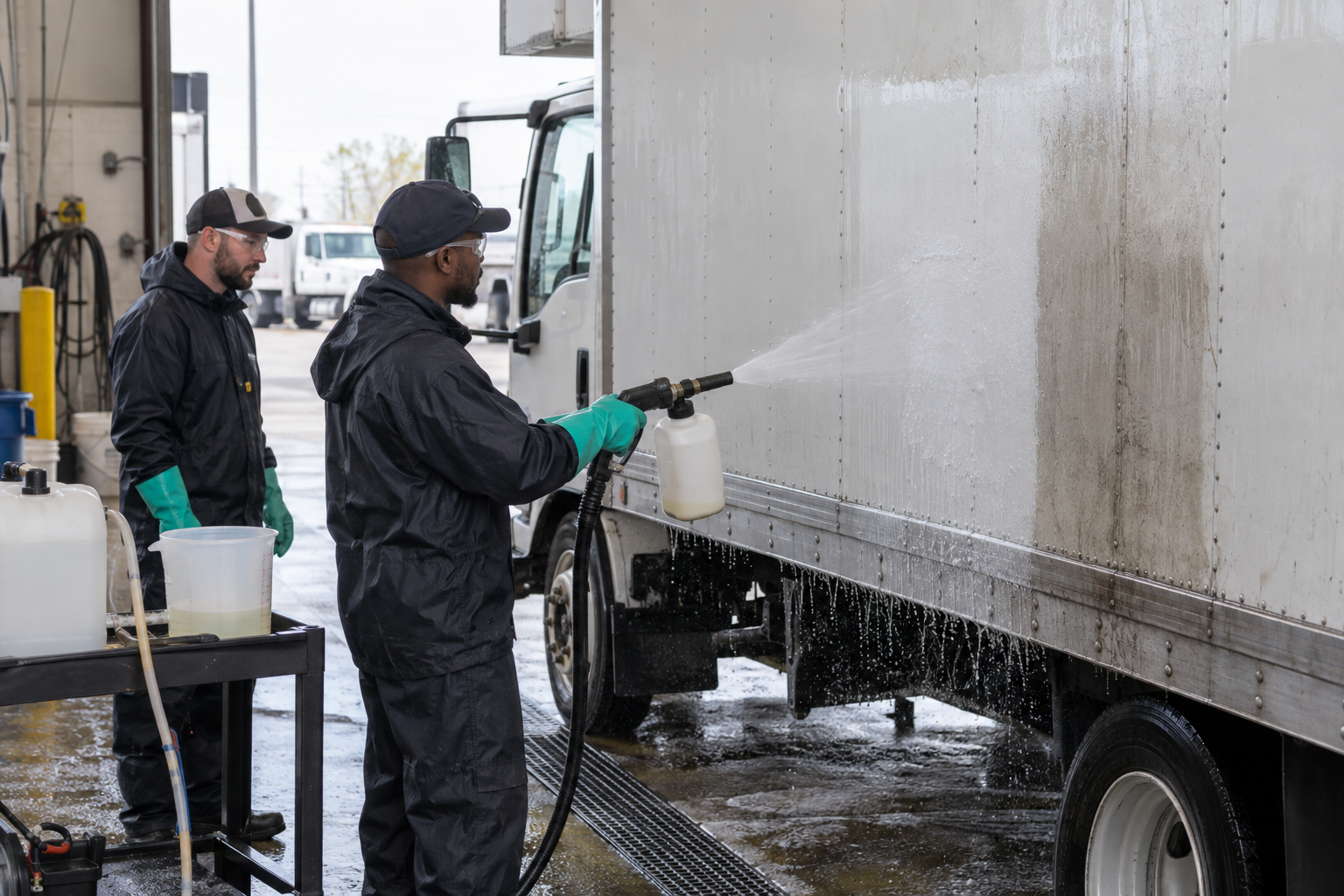
Run a controlled field trial
A field trial should answer whether the product works in your operation, not whether someone can make one test panel look clean.
Select representative vehicles with similar soil. Keep the equipment, operator, water, weather, section size, and inspection method as consistent as practical. Use only manufacturer-approved settings. Record the concentrate consumed, application time, brushing time, rinse time, total time, finish after drying, and any rewash.
Inspect more than the easiest broad panel. Include lower bodywork, rear doors, rivets, wheels, seams, and an identified sensitive surface. Check the vehicle again after it dries, because residue and spotting may not be obvious while the panel is wet.
For a recurring contract, repeat the trial through several wash cycles. A product that performs on a heavily soiled first wash may need a different maintenance setting once the fleet is on schedule.
Evaluate the supplier as part of the product
Commercial wash chemistry is easier to manage when the supplier can discuss the whole process. Look for access to current SDS documents, clear surface guidance, equipment knowledge, consistent supply, practical troubleshooting, and packaging that fits the site.
Ask what information the supplier needs before recommending a product. A responsible answer should consider the soil, surface, equipment, water, operating temperature, wastewater controls, and finish standard. Be cautious when a recommendation is based only on making more foam or increasing strength.
Keystone Clean-X manufactures professional vehicle and equipment cleaning products in Cinnaminson, New Jersey. Clout is listed as a truck and trailer wash, and the broader product catalog includes vehicle-wash, pre-soak, degreasing, and brightening chemistry for different jobs. Product selection should be confirmed with the Keystone Clean-X team for the specific surface and application.
Plan water use and discharge at the same time
Chemical performance is only one part of a functioning wash program. The U.S. Environmental Protection Agency recommends measuring water use per vehicle and considering efficient equipment, maintenance, and water reclamation where appropriate. Review EPA WaterSense guidance for vehicle washing.
Wash water can contain detergent plus oil, sediment, metals, and other material removed from the fleet. Confirm containment, treatment, and the approved discharge destination with the local authority before changing chemistry or wash volume.
A final buyer checklist
- The target soil and finish standard are documented.
- Every material the solution may contact has been considered.
- The product is compatible with the actual application equipment.
- Water hardness, reclaimed water, and seasonal temperature have been discussed.
- The label, technical sheet, and current SDS are available.
- The crew can follow the required dilution, PPE, storage, and emergency procedures.
- A representative field trial measures chemical, labor, rinse time, and rewashing.
- Wash-water collection and discharge have been approved.
- The supplier can support troubleshooting after the first order.
If you are comparing commercial truck wash soap for a fleet or distribution business in the Northeast or Mid-Atlantic, contact Keystone Clean-X with the vehicle types, soils, surfaces, equipment, water conditions, and wash frequency. Those details are more useful than asking for the strongest soap on the shelf.
Sources and further reading
Frequently asked questions
What is the best commercial truck wash soap?
There is no universal best soap. The right choice matches the fleet's soil, surfaces, water, equipment, wash frequency, safety controls, and required finish.
How should fleets compare concentrated truck wash soaps?
Measure the concentrate used per acceptable vehicle, then include labor, water, energy, rinsing, rewashing, and any finish correction. Drum price alone does not show operating cost.
Can one truck wash soap be used on every fleet vehicle?
Not always. Painted panels, polished or raw aluminum, decals, plastics, rubber, and specialty coatings can have different chemical tolerances. Confirm compatibility for every surface the solution may contact.
Does more truck wash foam mean better cleaning?
No. Foam can help show coverage, but foam volume does not prove that the detergent is releasing the fleet's soil. Judge the dried result, labor, product use, rinsing, and rewash rate.
Why should truck wash soap be tested before a bulk order?
A controlled field trial shows how the product behaves with the site's vehicles, soil, water, weather, equipment, operators, surfaces, and finish standard before the fleet commits to wider use.