
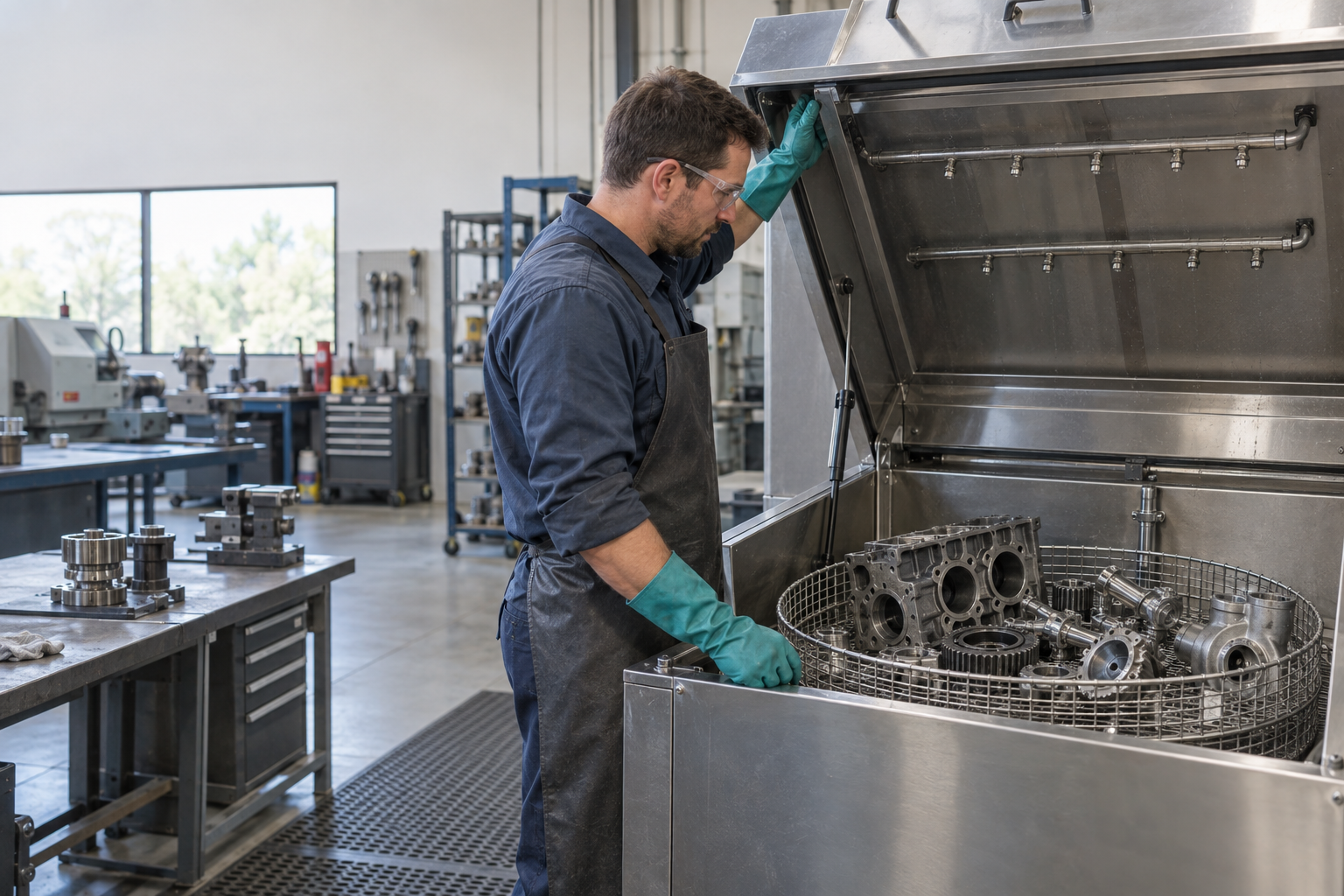
Choose a low-foam spray cabinet parts washer detergent that matches the soil, metals, washer temperature and water conditions. Verify concentration with the supplier's test method, maintain nozzles and filters, control contamination, and judge cost by clean accepted parts rather than container price alone.
A spray cabinet can turn a labor-heavy degreasing job into a repeatable batch process—but only when the detergent, machine, parts, and operating conditions work as one system. A product that removes oily soil in a bucket is not automatically suitable for a high-energy spray cabinet. The recirculating pump and nozzles continuously aerate the solution, so uncontrolled foam can interfere with the process and make a small chemistry mismatch look like an equipment failure.
The right spray cabinet parts washer detergent is therefore not simply the strongest degreaser. It is a low-foam cleaner selected for the actual soil, metal, finish, wash temperature, water, and downstream requirement. This guide explains how to make that choice and how to maintain the bath without wasting detergent or sending marginal parts back through the machine.
Product labels, the current Safety Data Sheet, the washer manual, and site-specific environmental and safety requirements must govern the work. Never use a general article as a substitute for those documents.
How a spray cabinet actually cleans parts
An aqueous spray cabinet relies on several forms of cleaning energy at the same time:
- Chemistry loosens or carries oily and particulate soil.
- Heat can improve soil removal when the detergent and part allow it.
- Mechanical spray action reaches exposed surfaces with recirculated solution.
- Time gives the combined process enough opportunity to work.
The U.S. Environmental Protection Agency describes aqueous parts cleaning as a process that uses water-based chemistry together with heat, agitation, and soap action. EPA guidance also notes that equipment selection matters because mechanical force and heat are central to performance. See EPA aqueous parts-cleaning guidance.
This matters when troubleshooting. If a blocked nozzle removes mechanical action from one zone, adding more detergent may not clean the shadowed surface. If the bath is below its specified operating temperature, a longer cycle may still leave greasy parts. If the detergent does not match the metal, stronger concentration can create a surface problem instead of a clean part.
Why low foam matters in a cabinet washer
Foam is not a measure of cleaning strength. In a manual wash, visible suds may seem reassuring. Inside a recirculating spray cabinet, however, the pump, falling solution, and spray impact introduce air continuously. A detergent made for hand washing or foam application can build a persistent head of foam under those conditions.
Excess foam can occupy tank space, escape through vents or seams, increase carryover, obscure the bath surface, and destabilize consistent spray delivery. It can also prompt operators to add an antifoam without first identifying the cause. EPA case material on aqueous conversion documented excessive foaming as an operational problem and the need to find a detergent that controlled foam while still cleaning adequately.
A purpose-made low-foam cabinet washer powder is designed for this high-agitation environment. Low foam does not eliminate the need to investigate a sudden change. A previously stable bath that begins foaming may be contaminated with another cleaner, coolant, soluble oil, or an incompatible process fluid.
Start with the soil, not the product name
Write down what must come off the part. Common loads include petroleum grease, machining oil, water-soluble coolant, carbonaceous residue, polishing compound, chips, shop dust, adhesive, and mixed soils. Then define what clean means for the next operation. A part going directly back into service may have a different acceptance standard from one headed to painting, plating, inspection, or precision assembly.
Do not pour free oil, loose chips, absorbent, or heavy sludge into the washer when it can be removed first. Scraping, draining, or wiping gross contamination reduces the load on the bath and filters. It also makes a detergent trial easier to interpret: the trial measures cleaning, not how well the machine stores avoidable debris.
For difficult soils, give the supplier representative examples of the worst representative part—not only an easy part that already cleans well. Include soil age, previous process fluids, required cycle time, and the cleanliness test used by the shop.
Confirm metal and finish compatibility
A mixed load may contain carbon steel, cast iron, stainless steel, aluminum, brass, copper-bearing alloys, zinc, coatings, seals, and plastic components. A detergent acceptable for ferrous rebuild parts may not be appropriate for a soft metal or a finished surface. Highly alkaline chemistry can change certain metals or finishes, while inadequate corrosion protection may allow flash rust after cleaning.
Ask the detergent supplier which substrates are covered by the written directions. When the alloy or coating is unknown, identify it before processing or run a documented test on a noncritical sample. Inspect the part after it is rinsed and fully dry. Look for darkening, etching, haze, staining, coating change, residue, and flash rust—not just oil removal while the part is wet.
Set a controlled starting process
Use the detergent manufacturer's starting concentration and the washer manufacturer's operating limits. Do not copy a setting from another shop or estimate powder by eye. Tank capacity, water hardness, soil loading, pump design, temperature, and parts mix can make two similar-looking cabinets behave differently.
A useful trial record includes:
- Detergent name, batch information, and measured concentration
- Water source and any treatment or hardness information available
- Bath and part temperature at the start of the cycle
- Cycle time and load weight or part count
- Part material, finish, soil type, and soil age
- Filter, nozzle, pressure, turntable, and oil-skimmer condition
- Result after rinsing and drying, including rework
Change one controlled variable at a time. If concentration, temperature, cycle time, and loading all change together, the shop cannot tell which adjustment helped.
Do not assume more detergent means cleaner parts
Under-concentration can reduce soil removal and corrosion protection where the formula provides it. Over-concentration can increase residue, chemical carryover, operating cost, rinsing demand, and compatibility risk. It may also hide a mechanical issue for a few cycles without correcting the root cause.
Use the test method specified by the detergent supplier. That may be a titration, conductivity-based method, or another product-specific check. A refractometer reading is not universally interchangeable across cleaners and contaminated baths. Record additions and allow the solution to mix before retesting.
Evaporation deserves special attention. When water leaves the tank but detergent remains, concentration can rise. Adding more chemical every time the level drops compounds the error. Follow the documented make-up procedure and distinguish water replacement from detergent replenishment.
Load parts so the spray can reach them
Cabinet loading is part of the cleaning formula. Avoid nesting parts, covering critical faces, or creating cups that hold dirty solution. Orient blind holes and cavities according to the washer guidance so they can drain. Secure small components in a suitable basket rather than letting spray pressure move them around the chamber.
A full basket is not always a productive basket. If extra parts create spray shadows or prevent rotation, throughput measured as clean, accepted parts per hour can fall even though more pieces entered the machine.
Maintain the bath by performance and condition
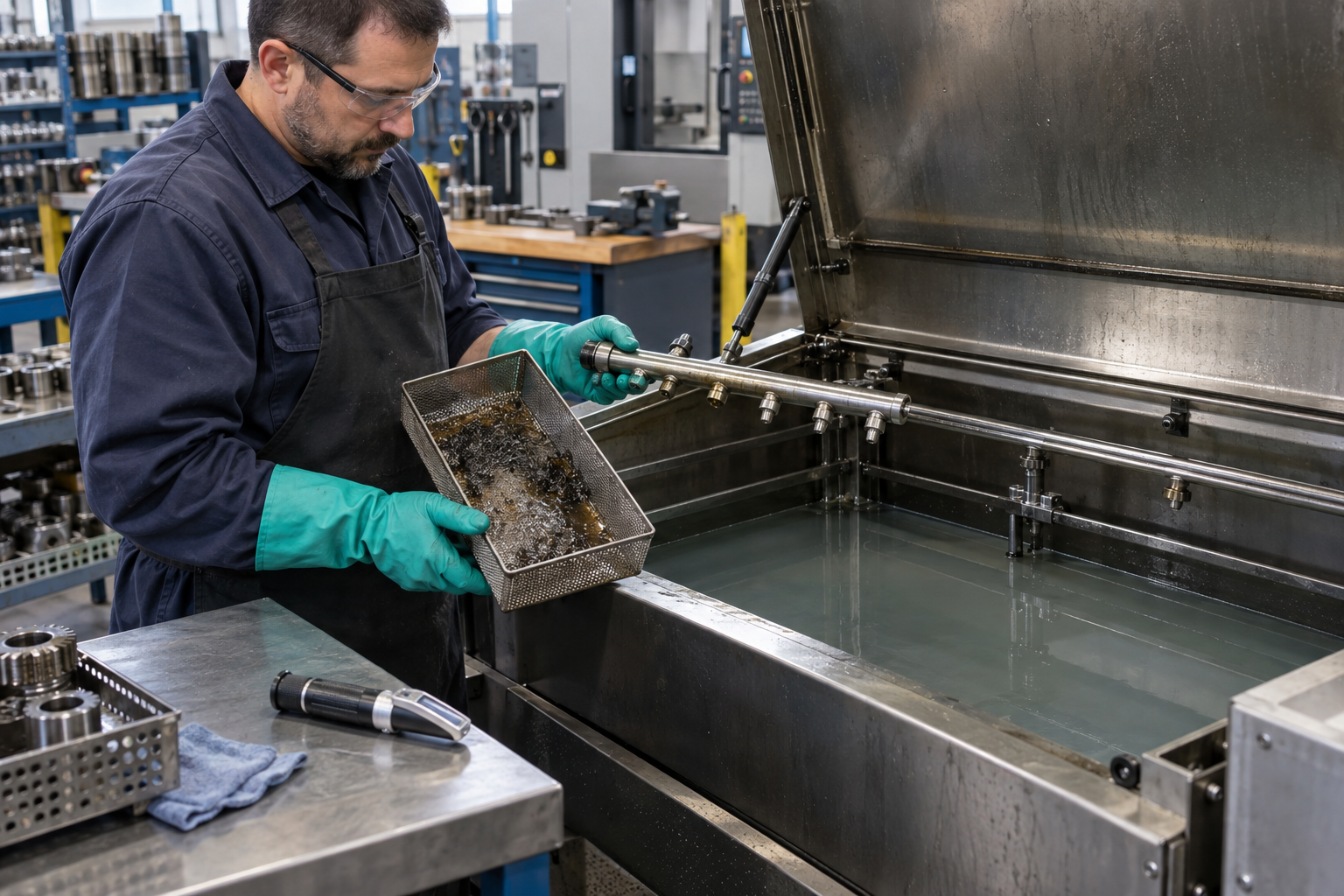
A dark bath is not automatically exhausted, and a clear bath is not automatically effective. EPA recommends filtering solids, skimming free oil where applicable, maintaining solution concentration, and changing aqueous solution when cleaning performance declines rather than solely because a calendar date arrives.
Build a short inspection into the operating routine:
- Remove accumulated chips and solids from baskets and strainers.
- Check spray nozzles for blockage, damage, and correct orientation.
- Verify turntable or rack movement and observe any pressure indicator provided by the machine.
- Skim free oil if the system and detergent are designed for oil separation.
- Measure bath temperature and concentration by the approved methods.
- Inspect for unexpected foam, odor, residue, or corrosion.
- Track first-pass cleaning results and the reason for any rewash.
Filtration and oil removal can extend useful bath life, but they do not make contaminants disappear. Sludge, spent filters, skimmed oil, and eventual bath disposal must be characterized and managed under applicable requirements.
Troubleshoot foam and cleaning failures systematically
| Symptom | Checks to make first | Why it matters |
|---|---|---|
| Foam appeared after a new load | Review incoming coolant, soap, oil, and previous cleaning residues on the parts | The load may have introduced a high-foam contaminant. |
| Foam increased after bath make-up | Verify the product, measured amount, water addition, mixing, and temperature | A wrong product or concentration error can change bath behavior. |
| One area of parts stays dirty | Inspect nozzle pattern, loading, rotation, and spray shadows | A localized result often points to lost mechanical coverage. |
| All parts gradually clean more slowly | Trend concentration, temperature, oil loading, solids, filters, and cycle conditions | Bath loading or a drifting control may be reducing performance. |
| Parts leave a powdery or sticky residue | Check concentration, rinsing, water quality, drainage, and drying | The fault may occur after soil removal rather than during it. |
| Flash rust appears after drying | Confirm alloy, detergent suitability, rinse, drying time, and corrosion-control plan | Post-wash exposure can determine the final condition. |
Do not add antifoam, solvent, caustic, or another detergent unless the chemical and equipment suppliers confirm compatibility. Uncontrolled additions can create a harder-to-manage mixture and may change cleaning, separation, disposal, and worker hazards.
Measure cost per accepted part
Price per pound or gallon is only one part of operating cost. Compare candidates using detergent consumption, energy, water, cycle time, labor, filter use, bath life, waste handling, rejected loads, and rewash. A concentrated powder that costs more per container may cost less per accepted part if the bath stays controlled and first-pass results improve. The reverse can also be true if it demands extra rinsing or is incompatible with the shop's metals.
Run a representative trial long enough to see contamination build rather than judging only the first clean charge. Agree on a written pass/fail standard before the test starts.
Worker and environmental controls still apply
Aqueous does not mean harmless. OSHA's Hazard Communication Standard requires workplace labels, accessible Safety Data Sheets, employee information, and training for hazardous chemicals. Review OSHA 29 CFR 1910.1200. Use the product-specific SDS to determine PPE, handling, storage, first aid, spill response, and incompatibilities.
Before inspecting filters, pumps, nozzles, or internal components, isolate the machine according to its manual and the facility's energy-control procedure. A closed cabinet does not remove exposure risks during charging, sampling, maintenance, or waste handling.
Spent aqueous solution can contain the oils, metals, coolants, and solids removed from the parts. Never assume it can go to a storm drain or sanitary sewer because the original detergent was water based. Confirm characterization, pretreatment, recycling, and disposal requirements with the local authority and the site's environmental professional.
Clean-X CW 77/DL Low Foam
Clean-X CW 77/DL Low Foam is in Keystone Clean-X's Parts & Cabinet Washer Powder range. Keystone's source catalog identifies CW 77/DL as a powdered detergent for spray and cabinet parts-washing machines.
Review the current Safety Data Sheet before use. For selection guidance, contact Keystone Clean-X with the washer make and capacity, operating temperature, metals and finishes, soil types, water conditions, present detergent, foam behavior, and the result required after drying. That information supports a useful recommendation without guessing at concentration or compatibility.
Sources and further reading
Frequently asked questions
Why does a spray cabinet parts washer need low-foam detergent?
The pump, nozzles and falling solution continuously introduce air. A low-foam detergent is formulated for that high-agitation environment, helping maintain stable spray operation and reducing foam carryover or overflow.
How much detergent should I add to a cabinet parts washer?
Use the product manufacturer's starting concentration for the specific washer and application, then measure it with the approved test method. Tank size, water, soil loading and detergent chemistry make a universal dose unreliable.
Can one cabinet washer detergent clean steel and aluminum parts?
Only when the detergent supplier confirms compatibility with both the exact metals and finishes. Test noncritical representative parts and inspect them after rinsing and drying for etching, darkening, residue or flash rust.
When should a cabinet washer bath be changed?
Change it when testing and performance show it can no longer be restored effectively—not just because it looks dark or a calendar date arrives. Track concentration, temperature, oil, solids, filter condition and first-pass cleaning results.
What causes sudden foam in a parts washer?
Common possibilities include the wrong detergent, a concentration or make-up error, and contamination carried in by coolant, hand soap, process fluid or another cleaner. Check recent changes before adding an antifoam or more chemistry.