For mushroom wash water treatment, map product-contact points, verify water quality and the exact approved product label, control organic load, measure label-required conditions, define corrective action, and keep reviewable records. Do not copy a dose or use claim from another chemical or facility.
If your mushroom operation washes product or recirculates process water, the important question is not simply which chemical to buy. It is whether the water, equipment, product label, monitoring method, and corrective-action plan work together on your actual line.
This mushroom wash water treatment checklist is for growers and packers evaluating a real process. Some facilities do not wash mushrooms, and their controls will differ. Do not add a treatment just because another facility uses one. Start with your food-safety plan and the applicable requirements for your operation.
1. Map where water touches the mushrooms
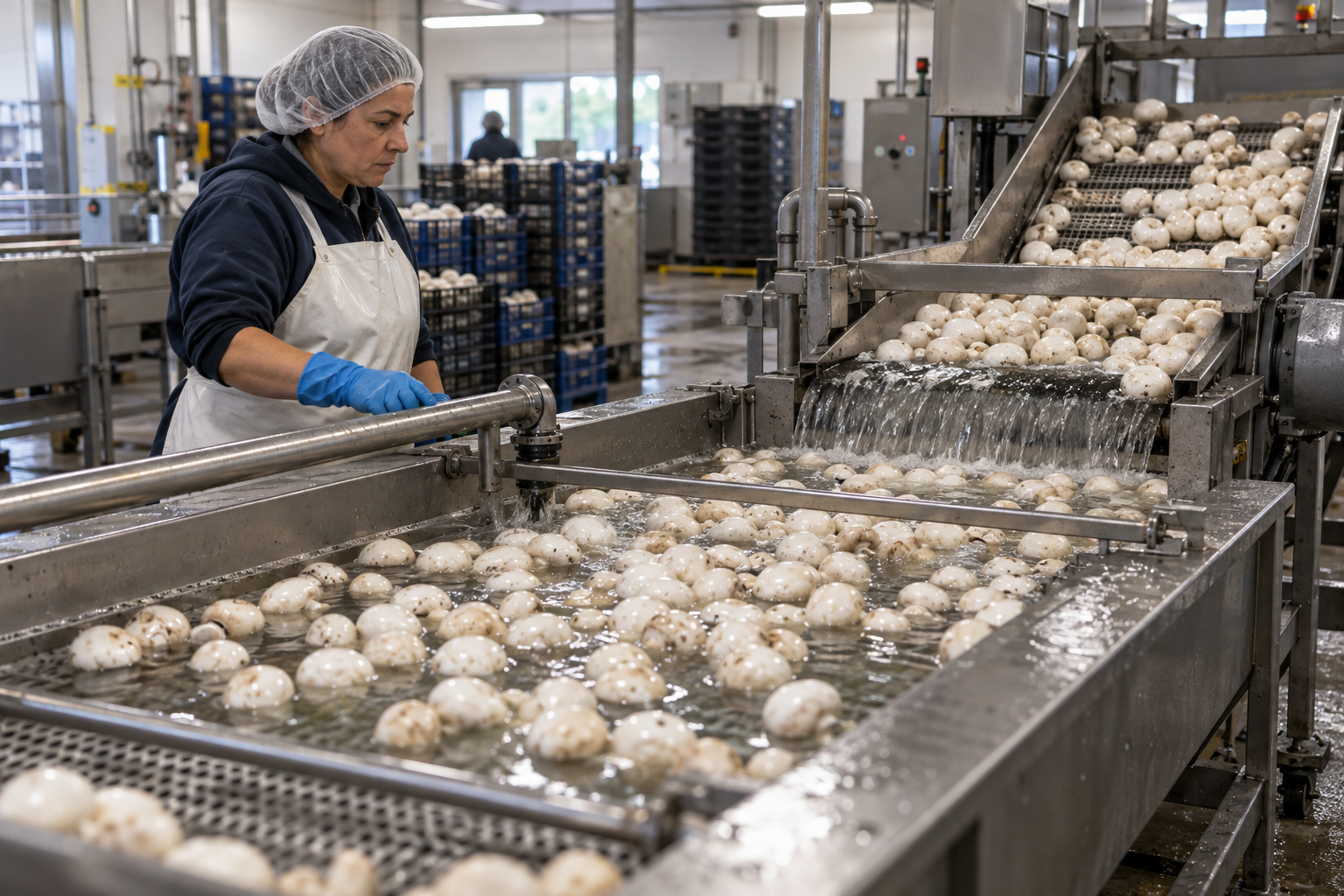
Walk the line from water entry to the last product-contact point. Mark fresh-water sprays, flumes, tanks, recirculation loops, drains, and any final rinse. Note where mushrooms, soil, spent substrate, or debris enter the system. A sample from the supply pipe does not necessarily describe water after a busy hour in a recirculating tank.
Write down whether water is single-pass or reused and how long product stays in contact with it. This makes the next decisions specific instead of generic.
2. Verify the source and the water at point of use
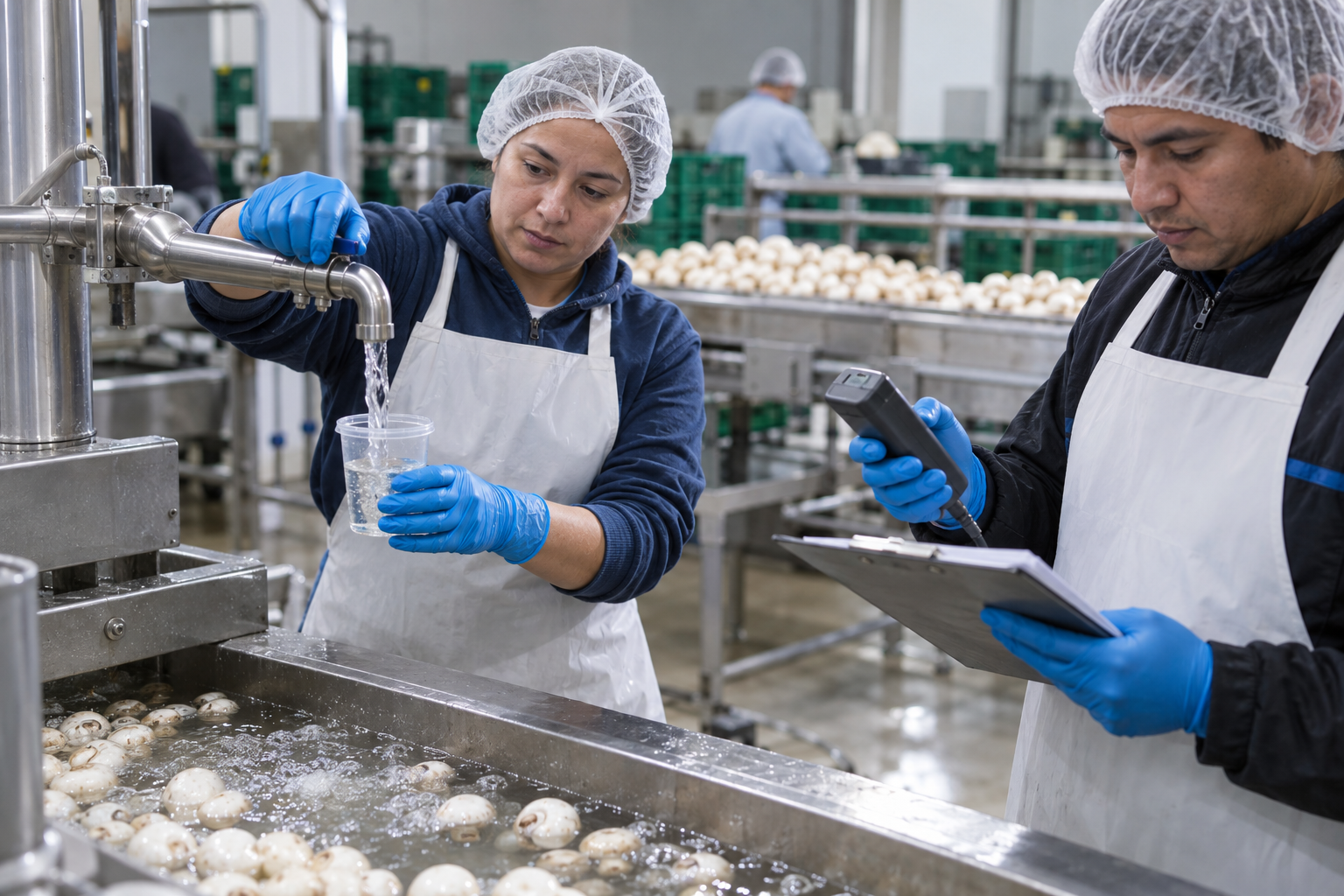
Identify the source, any treatment already installed, and the records that show water quality. Check the condition of storage tanks, pipes, filters, and backflow protection. Sample where water actually reaches the product, using the methods and frequency required by your food-safety program.
FDA explains that harvest and post-harvest agricultural water for covered produce must be safe and of adequate sanitary quality for its intended use. The detailed rule depends on the activity and operation. Review FDA's current post-harvest water guidance with your food-safety lead.
3. Check the exact product label, not just the SDS
Before purchasing a mushroom farm sanitation chemical, ask for its current EPA registration and label, where applicable. Confirm the label explicitly permits the intended site and use: direct mushroom wash, process-water treatment, equipment surface, or room treatment. Those are not interchangeable. Check application method, concentration, contact time, monitoring, rinsing, and any limitations.
A Safety Data Sheet tells workers about hazards and handling. It does not replace the use directions on a pesticide label. FDA notes that antimicrobial registrations are use-specific; a product registered for one water application cannot automatically be used for another. See FDA's agricultural-water treatment FAQ.
4. Plan for organic load
Mushrooms and handling equipment can carry soil and organic material into water. As that load builds, a treatment may not perform as expected. Set a practical rule for removing debris, checking filters, and replacing water. Keep the tank and return lines clean. Do not respond to dirty water by increasing chemical without verifying the label and the cause.
FDA's fresh-produce guidance notes that organic material can reduce antimicrobial effectiveness and that reused contaminated water can spread contamination. Read the FDA wash-water guidance.
5. Decide what to measure and when
Use the test method stated by the approved label and your food-safety procedure. Depending on the product, the critical checks may include active concentration, pH, temperature, contact time, or other operating conditions. Set measurement points at startup, during production, after water changes, and after any interruption that could affect control.
Write the acceptable range beside the record field so operators do not have to remember it. The range must come from the actual label and validated program, not a number borrowed from a different chemical.
6. Define the response to an out-of-range result
A log is useful only if the team knows what to do when a reading fails. The written procedure should say who stops the line, how affected product is identified and held, how water or feed equipment is corrected, which result permits restart, and who releases product. Include actions for a failed meter, an empty container, and a sudden increase in organic load.
Train the line lead before rollout. Test the procedure with a short tabletop exercise rather than discovering gaps during production.
7. Keep records someone can actually review
Record date, time, line, water source, product and lot, measurement, operator, corrective action, and verification after correction. Review the log for recurring failures, not only missing signatures. A drift that appears every afternoon may point to turnover, dosing equipment, or increasing soil load.
Keep the current label, SDS, calibration instructions, and food-safety procedure available to the people using them. Review the program when the water source, equipment, product, or process changes.
Where Keystone Clean-X products fit
Keystone Clean-X lists Duo-Brite 5 for mushroom washing and preparation. It also lists a Duo-Brite 8 / 12 / 15 / 24 / 25 family for mushroom and food-process applications. The grades are not interchangeable. Review the relevant Safety Data Sheet and obtain the current product label before choosing a use or setting a dose.
If you want help evaluating a specific line, contact Keystone Clean-X with the product-contact points, water source, single-pass or recirculating design, flow rate, current monitoring method, and intended use. Keystone is based in Cinnaminson, New Jersey and serves customers in New Jersey, Pennsylvania, New York, Delaware, Maryland, and Connecticut.
Sources and further reading
Frequently asked questions
Do mushroom packing facilities need to treat wash water?
Not every facility uses a wash step, and FDA does not require chemical treatment for every post-harvest water system. The water must be appropriate for its intended use, and the operation should select controls for its own process and applicable rules.
Can any food-processing sanitizer be used on mushrooms?
No. Check the current product label for the exact site and application. A room-surface sanitizer, process-water antimicrobial and direct product-contact wash are different uses.
What should a mushroom wash-water log include?
At minimum, capture line, date and time, water source, product and lot, required measurements, operator, corrective action and verification. Use the current label and food-safety plan to determine the specific limits and frequency.
Why can wash-water treatment stop working during a shift?
Organic material, changing water quality, low chemical feed, equipment faults or inadequate contact conditions can affect performance. Check the water and system at the point of use, not just at startup.
Is a Safety Data Sheet enough to set a mushroom wash-water dose?
No. The SDS covers hazards and handling. Use the current product label and the facility's approved procedure for allowed uses, concentration, contact time, testing and corrective action.