Remove winter salt and road film from aluminum trailers with a compatible detergent wash and thorough rinse first. Consider targeted mineral cleaning or aluminum brightening only after identifying the finish, inspecting the dried result, reviewing the product SDS, and completing a controlled compatibility test.
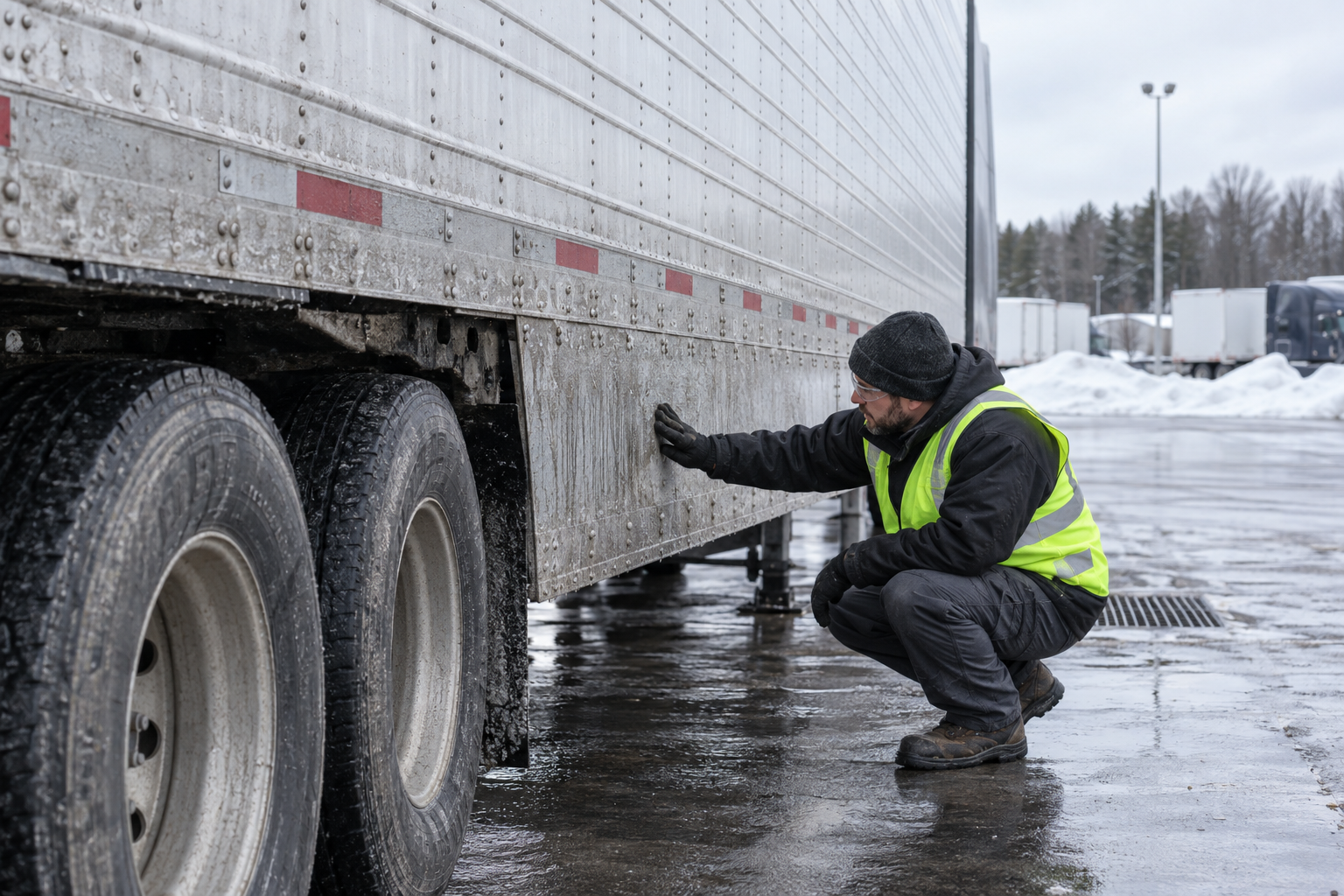
Winter road salt rarely appears on an aluminum trailer as clean white crystals. It mixes with water, traffic film, diesel residue, brake dust, and fine mineral soil, then dries into a dull gray layer along lower panels, wheels, seams, rivets, landing gear, and the front and rear of the trailer.
That buildup creates two separate questions. First, how should the fleet remove salt and road film? Second, does the aluminum actually need brightening? Those jobs are not the same. Routine cleaning removes contamination from the surface. Brightening intentionally changes the appearance of oxidized or stained aluminum with acidic chemistry and requires tighter surface, process, and worker-safety controls.
This guide helps Northeast and Mid-Atlantic fleets assess the problem before selecting an aluminum cleaner or aluminum brightener for trailers. Product labels, current Safety Data Sheets, equipment instructions, environmental requirements, and manufacturer guidance must control the actual work.
Why winter residue deserves a planned response
Road agencies use chloride-based deicers to keep highways operating during snow and ice. Vehicle spray carries the dissolved material onto trailers and underbody components. The Federal Highway Administration notes that highway deicing salt has been linked to corrosion of motor vehicles and unprotected steel structures. Review the FHWA discussion of salt use and corrosion.
Aluminum forms a thin oxide layer that normally helps protect it, but a trailer is not made from bare aluminum alone. Fasteners, frames, electrical connections, door hardware, wheels, painted components, reflective tape, seals, and dissimilar metals create different vulnerabilities. Salt-laden moisture can remain in seams and crevices after the broad panels look dry.
The practical goal is not to chase a mirror finish after every storm. It is to remove contamination before it remains trapped, inspect high-risk areas, and use stronger restoration chemistry only when the finish and business need justify it.
First identify the aluminum finish
The phrase aluminum trailer can describe several surfaces:
- Mill-finish sheet or extruded aluminum
- Polished aluminum tanks, wheels, trim, or panels
- Brushed or patterned diamond plate
- Painted or clear-coated aluminum
- Anodized aluminum components
- Previously brightened aluminum with an uneven history
These finishes should not be assumed to tolerate the same product. Chemistry that produces an acceptable uniform appearance on weathered mill-finish aluminum may haze, etch, whiten, or strip the appearance of a polished, coated, or anodized surface.
If the finish is unknown, check equipment records, ask the trailer or component manufacturer, and test an inconspicuous area. Photograph the surface before testing so the team can compare the dried result rather than relying on memory.
Separate salt, road film, oxidation and staining
Different conditions can look similar when the trailer is dirty. Diagnose them after an ordinary compatible wash and complete rinse.
| What you observe | Possible condition | Useful next question |
|---|---|---|
| White or gray residue that returns after drying | Salt, minerals, incomplete rinsing, or hard-water spotting | Was the contamination fully flushed from seams and was rinse-water quality checked? |
| Dark oily film on lower panels | Traffic film mixed with petroleum and brake residue | Does the detergent match the organic soil before any brightener is considered? |
| Uniform dullness on exposed aluminum | Normal oxidation, weathering, or previous chemical treatment | Is restoration necessary, and what finish does the fleet expect? |
| Vertical streaks or patchy white areas | Uneven application, drying chemistry, or prior etching | Can the original treatment history be identified before further work? |
| Pitting or damage around fasteners and joints | Corrosion or dissimilar-metal interaction | Does the area require maintenance inspection rather than cosmetic cleaning? |
Do not use acid brightening as a diagnostic shortcut. If detergent residue, oily film, or hard-water deposits are still present, strong acid can create an uneven result without solving the underlying process problem.
Cleaning and brightening are different jobs
Routine detergent cleaning
A compatible truck-wash detergent is generally the starting point for removing road film, salt-laden grime, and oily soil. The operator should work in manageable sections, prevent the solution from drying, and rinse seams, rivets, rails, wheels, and underbody areas thoroughly. This is maintenance cleaning, not metal restoration.
Targeted mineral-deposit treatment
When deposits remain after normal cleaning, a supplier may recommend chemistry intended for mineral scale or a particular stain. The recommendation should account for the exact aluminum finish and adjacent materials. A targeted process is preferable to applying stronger chemistry across the entire trailer without evidence that it is needed.
Aluminum brightening
Brightening uses acidic chemistry to remove oxidation and change the visual surface. It can leave a more uniform light appearance on suitable unfinished aluminum, but it is not polishing. It may also reveal existing variation, weld marks, repairs, or prior etching. The result should be agreed upon before the work begins.
Some professional aluminum brighteners contain hydrofluoric acid. Others use different acid systems. The product name is not enough to establish the hazard or surface suitability; the current SDS and label must be reviewed for the specific formulation.
Hydrofluoric acid requires exceptional controls
Hydrofluoric acid is not an ordinary acid cleaner. The Centers for Disease Control and Prevention reported serious occupational HF injuries in car and truck washing, including the risk of deep tissue damage and potentially fatal systemic toxicity. Pain and visible injury can be delayed after exposure to dilute solutions. Read the CDC report on HF injuries in vehicle washing.
Any workplace considering an HF-containing product needs trained personnel, product-specific engineering and administrative controls, compatible chemical-resistant PPE, accessible SDS information, an exposure-response plan, and immediate medical-response procedures based on professional occupational-safety guidance. A generic blog cannot establish those controls.
Workers should never transfer an aluminum brightener into an unlabeled container, rely on ordinary work gloves, or assume that lack of pain means an exposure was harmless. If exposure occurs, follow the SDS emergency instructions and obtain immediate medical assistance.
Use a documented compatibility test
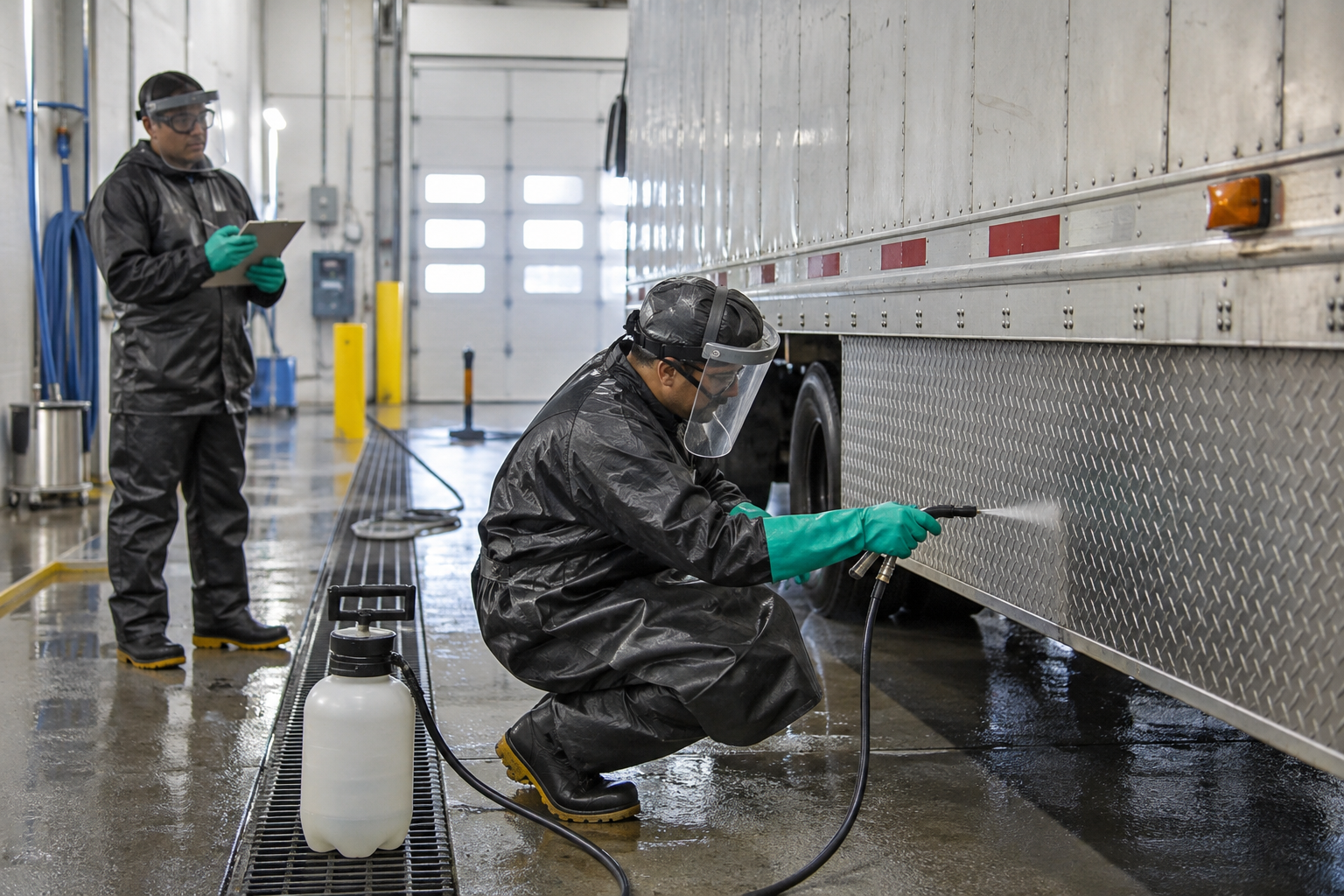
A test section helps answer whether the product, concentration, equipment, finish, water, temperature, and operator method work together. Choose an inconspicuous location that represents the target surface. Keep the test away from decals, damaged coatings, electrical components, and dissimilar materials unless those items are specifically being evaluated.
Follow the product's written preparation, application, dwell, and rinse directions. Record:
- Product name and current lot or container identification
- Surface type and existing condition
- Water source and approximate temperature
- Application equipment and verified concentration
- Air and panel conditions
- Start, dwell, and rinse timing specified by the manufacturer
- Appearance when wet and after complete drying
Inspect for uniformity, haze, whitening, streaking, darkening, loss of polish, coating change, and residue. A clean-looking wet panel is not an adequate approval standard.
Build a winter trailer-cleaning sequence
The exact chemistry varies, but a reliable maintenance program follows a consistent decision process:
- Inspect before washing. Note the finish, existing damage, repairs, mixed metals, decals, lights, and heavy deposits.
- Remove loose accumulation. Clear packed snow, ice, mud, and grit using methods approved for the vehicle and site.
- Perform routine cleaning first. Use a compatible detergent process to remove traffic film and oily soil.
- Rinse high-risk areas thoroughly. Flush lower rails, seams, rivets, wheel areas, landing gear, rear frames, and locations that trap solution.
- Inspect after drying. Distinguish remaining mineral deposits or oxidation from residue left by the wash.
- Escalate only where justified. Use a supplier-approved targeted cleaner or brightening process after compatibility is established.
- Document the result. Keep photos and process notes so the next wash is based on evidence.
This sequence prevents a common mistake: reaching for an aluminum brightener when the real issue is ordinary road film, poor rinsing, hard water, or salt trapped in joints.
Do not overlook adjacent materials
Even when the broad trailer panel is compatible, runoff can reach painted frames, galvanized hardware, stainless trim, glass, rubber, electrical connectors, lights, reflective tape, wheels, and concrete. Review the entire flow path, including overspray and the rinse route. Protect or avoid incompatible components according to the product manufacturer's instructions.
Pay particular attention to polished wheels and tanks. A worker concentrating on the trailer side can unintentionally change the appearance of a nearby polished component through overspray or runoff.
Manage wash water containing salt and metals
Trailer wash water may contain detergent, dissolved salt, sediment, oil, grease, metals, and any treatment chemistry used. The U.S. Environmental Protection Agency recommends designated wash areas that contain and direct wash water to an approved sanitary sewer, holding tank, treatment system, or recycling system, depending on local approval. Review EPA vehicle and equipment washing practices.
Do not assume that a biodegradable detergent makes the full waste stream suitable for a storm drain. The contamination removed from the trailer remains in the water. Confirm the site's discharge requirements with the local sewer or environmental authority.
Questions to ask an aluminum-cleaning supplier
- Is the product intended for cleaning, mineral removal, deoxidizing, or brightening?
- Which aluminum finishes and adjacent materials are compatible?
- Does the formulation contain hydrofluoric acid or another fluoride compound?
- What trained-user, PPE, ventilation, storage, spill, and emergency controls are required?
- Which application equipment and final concentration are approved?
- What temperature, dwell, drying, and rinse limits apply?
- What visible finish should the fleet expect after drying?
- How should remaining product and collected wash water be handled?
Keystone Clean-X aluminum products
The Keystone Clean-X catalog includes an Aluminum Brightener and Acid Cleaner category covering products identified for aluminum brightening, deoxidizing, scale removal, or related acidic cleaning applications. Some entries carry serious corrosive or hydrofluoric-acid hazards, and some applications in the product-use guide are explicitly identified as inferred.
Review the current Safety Data Sheet library and contact Keystone Clean-X before selecting a product for a trailer, tank, wheel, diamond plate, or mixed-material assembly. Provide photographs, finish information, the existing soil or oxidation, wash equipment, water conditions, and the intended final appearance.
Sources and further reading
Frequently asked questions
Does road salt damage aluminum trailers?
Chloride residue can hold moisture and contribute to corrosion problems across mixed trailer assemblies, especially around seams, fasteners, frames and dissimilar metals. Prompt cleaning and inspection help reduce prolonged exposure.
Is aluminum brightener the best way to remove road salt?
Not usually as the first step. Begin with a compatible detergent wash and complete rinse. Use stronger mineral-removal or brightening chemistry only when remaining deposits or oxidation justify it and surface compatibility is confirmed.
Can aluminum brightener be used on polished aluminum?
Do not assume it can. Acidic chemistry may haze, etch or whiten polished, anodized, coated or previously treated aluminum. Obtain written manufacturer guidance and test an inconspicuous area first.
What is the difference between cleaning and brightening aluminum?
Cleaning removes road film, salt and oily contamination from the surface. Brightening uses acidic chemistry to remove oxidation and intentionally alter the appearance of suitable unfinished aluminum.
Why is hydrofluoric acid especially hazardous in truck washing?
Hydrofluoric acid can penetrate tissue, cause deep injury and produce potentially fatal systemic toxicity. Pain and visible damage may be delayed, so HF-containing products require product-specific professional controls and immediate medical-response planning.